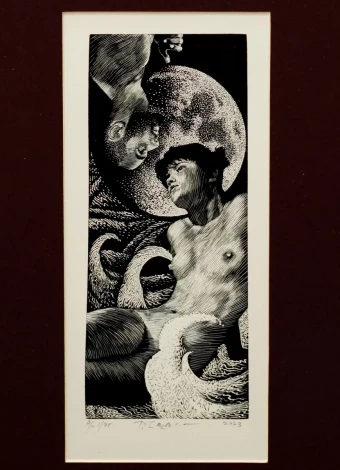
Peter Lazarov is among those artists who not only preserve the tradition of graphics, but also develop it beyond national borders. Born in Plovdiv in 1958, he dedicated his creative path to one of the most difficult and demanding graphic techniques - woodcut, turning it into his distinctive artistic language. A graduate of the Graphics Department at the University of Veliko Tarnovo, Lazarov built an international career that ranks him among the most respected contemporary Bulgarian graphic artists.
His works impress with exceptional precision and attention to detail. In the complex labyrinths of lines, natural forms, human figures, symbols and stories are intertwined, revealing a rich and multi-layered visual universe. Regardless of whether he creates easel graphics, bookplates or bibliophile editions, the author remains true to his understanding of graphics as an art of patience, mastery and internal discipline.
Asia occupies a special place in his creative path. After specializations in Japan, dedicated to traditional handmade paper production and classical printing techniques, Lazarov spent nearly two decades in China as a teacher of woodcut and ex-libris at the Sichuan Institute of Arts. This period left a lasting mark on his work, where the European graphic tradition meets the Eastern sensitivity to rhythm, space and line.
He is the recipient of numerous prestigious international awards and distinctions, and his works are kept in the collections of the Rijksmuseum in Amsterdam, the Ashmolean Museum in Oxford, the Victoria and Albert Museum in London, the Library of Congress in Washington and a number of significant museum and university collections around the world. In 2008, he was selected among the ten best graphic artists at the World Ex-libris Congress in Beijing – a recognition that confirms his place among the leading names in contemporary graphic art.
Today, Peter Lazarov lives and works again in Bulgaria, continuing to actively participate in exhibitions and international graphic forums. His works are proof that classical graphics do not belong to the past – they remain a living, relevant and impressive art in the hands of a true master.